Showcase
This article presents several example Tusk programs,
showcasing the capabilities of the language.
You can define new records in Tusk,
but for now, you can only define fields
(no methods or properties).
Methods and properties are on the horizon,
but for now, you can work around their absence
by defining a record with anonymous methods.
For example, let's suppose we wanted to make
a TEmployee record like this…
type
TEmployee = record
private
FName: string;
FSalary: Double;
public
property Name: string read FName;
property Salary: Double read FSalary;
procedure GiveRaise(Value: Double);
procedure Show;
end;
The work-around is as follows…
type
TFunc_string = reference to function: string;
TFunc_Double = reference to function: Double;
TProc_Double = reference to procedure(Value: Double);
TEmployee = record
Name: TFunc_string;
Salary: TFunc_Double;
GiveRaise: TProc_Double;
Show: TProc;
end;
function NewEmployee(
const Name: string; Salary: Double): TEmployee;
begin
Result.Name :=
function: string
begin
Result := Name;
end;
Result.Salary :=
function: Double
begin
Result := Salary;
end;
Result.GiveRaise :=
procedure(Value: Double)
begin
Salary := Salary + Value;
end;
Result.Show :=
procedure
begin
Writeln(Name, ': ', Salary);
end;
end;
With the above in place, we can work with TEmployee
instances…
var Emp1 := NewEmployee('Will Williams', 1_000);
var Emp2 := NewEmployee('Dave Davidson', 2_000);
Emp1.Show;
Emp2.Show;
Writeln(Emp2.Salary);
Emp2.GiveRaise(500);
Emp2.Show;
Writeln(Emp2.Salary);
The above prints…
Will Williams: 1000
Dave Davidson: 2000
2000
Dave Davidson: 2500
2500
We can shorten NewEmployee function using Tusk's
One-Line Routines…
function NewEmployee(
const Name: string; Salary: Double): TEmployee;
begin
Result.Name := function = Name;
Result.Salary := function = Salary;
Result.GiveRaise := procedure(Value: Double) =
Salary := Salary + Value;
Result.Show := procedure =
Writeln(Name, ': ', Salary);
end;
This work-around is certainly not ideal,
but it does offer an effective mechanism
for encapsulation.
Tusk supports both Traditional
and Fluent SQL.
Note that Tusk doesn't yet have anything similar to
MiniCalc's pre-processing step
that implicitly defines aliases to tables, parameters,
and condition lists.
Thus, for the time being, Tusk programs must explicitly
declare variables of type VDB.TAlias, VDB.TParam,
VDB.TCond, and VDB.TScope.
Here's a good example…
const Company = 'FTP';
const Profile =
'vdb:vdbEngine=ODBC;DRIVER=ODBC Driver 18 for SQL Server;' +
'ENCRYPT=Optional;PASSWORD=x;SERVER=DevEntSQLDB\Dev;' +
'TRUSTED_CONNECTION=Yes;DATABASE=Enterprise;' +
'vdbDialect=SQLServer;vdbOption:NAME=Alias;' +
'vdbOption:LINKEDREADONLY=False;vdbPoolTimeout=300';
const ReadOnlyDB = OpenDatabase(Profile);
var e, t, t2, m, u: VDB.TAlias;
var Reader := ReadOnlyDB.RunReader(VDB
.Select(e.Col('last_name'))
.Select(e.Col('first_name'))
.Select(e.Col('middle_name'))
.Select(e.Col('name_suffix'))
.Select(e.Col('dept_name'))
.Select(e.Col('dept_role'))
.Select(e.Col('company_code'))
.Select(e.Col('position'))
.Select(u.Col('user_id'))
.Select(t.Col('title_code'))
.From(e.Table('hr_employee_view'))
.LeftJoin(t.Table('hr_title_hist'))
.On(t.Col('employee_id') = e.Col('employee_id'))
.LeftJoin(m.Table('hr_employee_view'))
.On(m.Col('employee_id') = e.Col('mgr_employee_id'))
.LeftJoin(u.Table('app_user'))
.On(u.Col('person_id') = e.Col('person_id'))
.AndWhere(t.Col('effective_date') = VDB
.Select(VDB.Max(t2.Col('effective_date')))
.From(t2.Table('hr_title_hist'))
.Where(t2.Col('employee_id') = t.Col('employee_id'))
)
.AndWhere(e.Col('company_code') = VDB.Param(Company))
.AndWhere(e.Col('employee_stat_code') = VDB.Param('A'))
.OrderBy(m.Col('last_name'))
.OrderBy(m.Col('first_name'))
.OrderBy(e.Col('last_name'))
.OrderBy(e.Col('first_name'))
);
for Reader in Reader do
Writeln(Reader['last_name']);
This short Tusk program implements a very simple
"Slalom Skiing" game, inspired by
games from long ago.
You control the skier, represented by an asterisk.
Using the ← and → arrows,
you try to stay within the bounds of the
winding track as the game progresses.
This is what the game looks like…
=================================> * <===================================
================================> * <====================================
===============================> *<=====================================
================================> *<====================================
=================================> * <===================================
==================================> * <==================================
===================================> * <=================================
====================================> * <================================
=====================================> * <===============================
======================================> * <==============================
=======================================> * <=============================
========================================> * <============================
=========================================>* <===========================
==========================================>* <==========================
===========================================>* <=========================
============================================>* <========================
=============================================>* <=======================
==============================================>* <======================
===============================================>* <=====================
================================================>* <====================
=================================================>* <===================
==================================================>* <==================
=================================================> * <===================
================================================> * <====================
=================================================> * <===================
==================================================> * <==================
===================================================> * <=================
====================================================>* <================
=====================================================O <===============
Game Over. Score: 136
The source code for this game is as follows.
Note the two comments, which are hints to DSEdit.exe and Tusk.exe.
The first one disables the introductory banner,
and the second one skips the final "Hit ENTER..." prompt.
// Tusk:Quiet
// Tusk:NoPause
type
TDirection = (dirNone, dirLeft, dirRight);
TGameStatus = (gsRunning, gsHit, gsGameOver);
TGameState = record
Margin: Integer;
Gap: Integer;
Player: Integer;
Delta: Integer;
Speed: Integer; // frame time in ms
FlipPct: Integer; // probability percent to flip tunnel direction
Score: Integer;
Lives: Integer;
Status: TGameStatus;
end;
TGameConfig = record
Dirt: Char;
LeftEdge: Char;
RightEdge: Char;
Width: Integer;
MinMargin: Integer;
MarginAccel: Integer;
MaxSpeed: Integer;
Accel: Integer;
MinFlipPct: Integer;
MaxFlipPct: Integer;
FlipPctDelta: Integer;
FlipPeriod: Integer;
end;
function StartingConfig: TGameConfig;
begin
Result.Dirt := '=';
Result.LeftEdge := '>';
Result.RightEdge := '<';
Result.Width := 80;
Result.MinMargin := 5;
Result.MarginAccel := 20;
Result.MaxSpeed := 50;
Result.Accel := 2;
Result.MinFlipPct := 10;
Result.MaxFlipPct := 50;
Result.FlipPctDelta := 10;
Result.FlipPeriod := 30
end;
const
Cfg = StartingConfig;
// -- helpers --
function TunnelLeftEdge(const G: TGameState): Integer;
begin
// the number of dirt chars on the left
Result := G.Gap;
end;
function TunnelRightEdge(const G: TGameState): Integer;
begin
// the number of dirt chars on the right
Result := Cfg.Width - G.Gap - G.Margin*2 - 1;
end;
function TunnelInnerLeftPos(const G: TGameState): Integer;
begin
// index (0-based) of the left edge character '>' in the printed line
Result := G.Gap;
end;
function TunnelInnerRightPos(const G: TGameState): Integer;
begin
// index (0-based) of the right edge character '<' in the printed line
Result := G.Gap + G.Margin*2 + 1;
end;
// -- initialization --
procedure InitGame(var G: TGameState);
begin
G.Margin := 10;
G.Gap := Cfg.Width div 2;
G.Player := G.Gap + G.Margin;
G.Delta := Random(2)*2 - 1; // either -1 or +1
G.FlipPct := 20;
G.Speed := 200;
G.Score := 0;
G.Lives := 3;
G.Status := gsRunning;
end;
// -- input --
function ReadGameInput(ElapsedMS: Integer; var Quit: Boolean): TDirection;
var
Timer: ITimer;
KS: TKeystroke;
begin
Result := dirNone;
Timer := StartNewTimer;
// Poll for keystrokes until the frame time expires
while Timer.ElapsedMS < ElapsedMS do begin
if not KeystrokeReady(kkNonModifier) then begin
Sleep(Min(ElapsedMS - Integer(Timer.ElapsedMS), 10));
Continue;
end;
KS := ReadKeystroke(kkNonModifier);
// Windows virtual-key codes: 37 = left, 39 = right, 27 = Escape
if (KS.Key = 37) and (KS.Scan = 75) then begin
Result := dirLeft;
Exit;
end else if (KS.Key = 39) and (KS.Scan = 77) then begin
Result := dirRight;
Exit;
end else if (KS.Key = 27) and (KS.Scan = 1) then begin
Quit := True;
Exit;
end else begin
// unexpected key: show it then pause briefly so user sees debug
Writeln;
Show(KS);
Sleep(10*1000);
end;
end;
end;
// -- rendering --
procedure RenderLine(const G: TGameState);
var
leftCount, rightCount: Integer;
Line: string;
playerIdx: Integer;
begin
leftCount := TunnelLeftEdge(G);
rightCount := TunnelRightEdge(G);
Line := ''
+ StringOfChar(Cfg.Dirt, leftCount)
+ StringOfChar(' ', G.Margin*2 + 1)
+ StringOfChar(Cfg.Dirt, rightCount)
+ ' ';
// place the visual edge markers
Line[TunnelInnerLeftPos(G)+1] := Cfg.LeftEdge;
Line[TunnelInnerRightPos(G)+1] := Cfg.RightEdge;
// decide what to place for the player
playerIdx := G.Player + 1; // convert to 1-based string index
if (playerIdx >= 1) and (playerIdx <= Length(Line)) then begin
if Line[playerIdx] = ' ' then
Line[playerIdx] := '*'
else
Line[playerIdx] := 'O';
end;
Write(Line);
end;
// -- collision --
procedure HandleCollision(var G: TGameState);
begin
Dec(G.Lives);
G.Status := gsHit;
if G.Lives <= 0 then
G.Status := gsGameOver;
// reset player to safe start if still alive
if G.Status <> gsGameOver then
G.Player := G.Gap + G.Margin;
end;
function IsPlayerInTunnel(const G: TGameState): Boolean;
var
// inclusive positions of tunnel interior (0-based)
leftPos, rightPos: Integer;
begin
// interior space starts after '>'
leftPos := TunnelInnerLeftPos(G)+1;
// interior space ends before '<'
rightPos := TunnelInnerRightPos(G)-1;
Result := (G.Player >= leftPos) and (G.Player <= rightPos);
end;
// -- tunnel update --
procedure UpdateTunnel(var G: TGameState);
begin
// bounce at edges
if G.Gap <= 0 then begin
G.Gap := 1;
G.Delta := +1;
end else if G.Gap >= Cfg.Width - G.Margin*2 - 2 then begin
G.Gap := Cfg.Width - G.Margin*2 - 3;
G.Delta := -1;
end else begin
// random flip based on percentage
if Random(100) < G.FlipPct then
G.Delta := -G.Delta;
Inc(G.Gap, G.Delta);
end;
end;
// -- difficulty --
procedure UpdateDifficulty(var G: TGameState);
begin
// Margin reduction first, then speed improvements
if G.Margin > Cfg.MinMargin then begin
if G.Score mod Cfg.MarginAccel = 0 then
Dec(G.Margin);
end else begin
if (Cfg.Accel > 0) and (G.Score mod Cfg.Accel = 0) then begin
if G.Speed > Cfg.MaxSpeed then
Dec(G.Speed);
end;
end;
// Flip percentage oscillation
if (Cfg.FlipPeriod > 0)
and (G.Score mod Cfg.FlipPeriod = 0) then begin
if G.FlipPct = Cfg.MinFlipPct then
Inc(G.FlipPct, Cfg.FlipPctDelta)
else if G.FlipPct = Cfg.MaxFlipPct then
Dec(G.FlipPct, Cfg.FlipPctDelta)
else if Random(2) = 0 then
Inc(G.FlipPct, Cfg.FlipPctDelta)
else
Dec(G.FlipPct, Cfg.FlipPctDelta);
end;
end;
// -- single frame execution --
procedure RunFrame(var G: TGameState; var Quit: Boolean);
var
dir: TDirection;
begin
// Advance tunnel geometry
UpdateTunnel(G);
// Prepare and render the line
RenderLine(G);
// Check collision purely in logical space before reading input
if not IsPlayerInTunnel(G) then begin
// show collision visually as 'O'
// (render already placed O if collision)
HandleCollision(G);
if G.Status = gsGameOver then begin
Quit := True;
Exit;
end;
end;
// Wait for input within the frame time
dir := ReadGameInput(G.Speed, Quit);
if Quit then
Exit;
// Apply player movement
case:strict dir of
dirLeft:
if G.Player > 0 then
Dec(G.Player);
dirRight:
if G.Player < Cfg.Width - 1 then
Inc(G.Player);
dirNone: (* nothing *);
end;
// Score and difficulty
Inc(G.Score);
UpdateDifficulty(G);
// If hit state was set, return to running
if G.Status = gsHit then
G.Status := gsRunning;
// Write score on its own line (keeps output moving)
Writeln(G.Score);
end;
// -- top-level runner --
procedure RunGame;
var
G: TGameState;
Quit: Boolean;
begin
InitGame(G);
Quit := False;
while not Quit do begin
RunFrame(G, Quit);
if (G.Status = gsGameOver) or Quit then
Break;
end;
Writeln;
Writeln('Game Over. Score: ', G.Score);
end;
// -- entry point --
procedure Main;
begin
RunGame;
end;
Main;
Readln;
To run this program, copy the above code into a new tab
in DSEdit, set the highlighter to "Tusk", and hit F9.
You have three "lives", but be warned –
the game speeds up as time passes!
Hit Esc to quit immediately.
Here is a direct link the file…
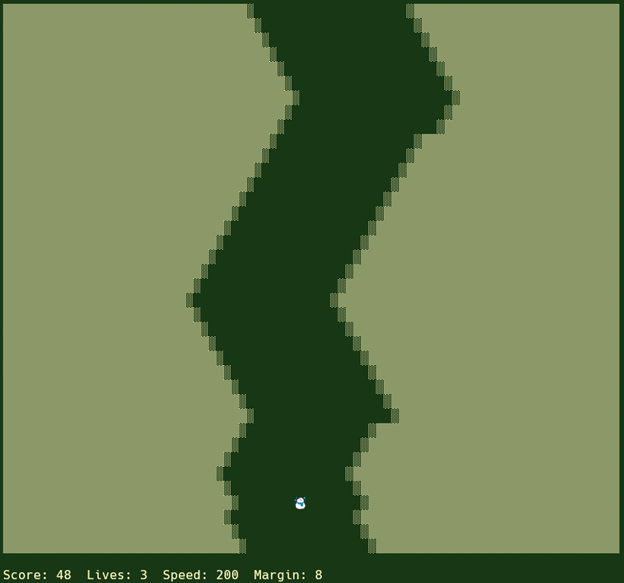
This example program is an evolution of the previous one.
This version uses Windows Console API functions to draw
characters at specific locations.
This allows the skier to appear a few lines above the
bottom of the screen, and eliminates the trail of skiers
left behind as you go – significant improvements.
Here's what the program looks like in action…
 The source code for this game is as follows.
Note the two comments, which are hints to DSEdit.exe and Tusk.exe.
The first one disables the introductory banner,
and the second one skips the final "Hit ENTER..." prompt.
// Tusk:Quiet
// Tusk:NoPause
{$Include Console.tusk}
type
TDirection = (dirNone, dirLeft, dirRight);
TGameStatus = (gsRunning, gsHit, gsGameOver);
TTunnelState = record
Gap: Integer;
Margin: Integer;
end;
TGameState = record
Margin: Integer;
Gap: Integer;
Player: Integer;
Delta: Integer;
Speed: Integer; // frame time in ms
FlipPct: Integer; // probability percent to flip tunnel direction
Score: Integer;
Lives: Integer;
Status: TGameStatus;
ScreenWidth: Integer;
ScreenHeight: Integer;
PlayfieldHeight: Integer;
// circular buffer for tunnel history
TunnelBuffer: TArray<TTunnelState>;
BufferHead: Integer; // next position to write
end;
TGameConfig = record
Dirt: Char;
LeftEdge: Char;
RightEdge: Char;
Width: Integer;
MinMargin: Integer;
MarginAccel: Integer;
MaxSpeed: Integer;
Accel: Integer;
MinFlipPct: Integer;
MaxFlipPct: Integer;
FlipPctDelta: Integer;
FlipPeriod: Integer;
PlayerRowOffset: Integer; // how many rows above bottom to show player
end;
function StartingConfig: TGameConfig;
begin
Result.Dirt := #$2592; // Medium Shade
Result.LeftEdge := #$2591; // Light Shade
Result.RightEdge := #$2591; // Light Shade
Result.Width := 80;
Result.MinMargin := 5;
Result.MarginAccel := 20;
Result.MaxSpeed := 50;
Result.Accel := 2;
Result.MinFlipPct := 10;
Result.MaxFlipPct := 50;
Result.FlipPctDelta := 10;
Result.FlipPeriod := 30;
Result.PlayerRowOffset := 4; // player is 4 rows above bottom
end;
const
Cfg = StartingConfig;
// -- helpers --
function TunnelLeftEdge(
Gap, Margin: Integer): Integer;
begin
Result := Gap;
end;
function TunnelRightEdge(
Gap, Margin: Integer): Integer;
begin
Result := Cfg.Width - Gap - Margin*2 - 1;
end;
function TunnelInnerLeftPos(
Gap: Integer): Integer;
begin
Result := Gap;
end;
function TunnelInnerRightPos(
Gap, Margin: Integer): Integer;
begin
Result := Gap + Margin*2 + 1;
end;
// -- buffer management --
procedure AddTunnelToBuffer(
var G: TGameState;
Gap, Margin: Integer);
begin
G.TunnelBuffer[G.BufferHead].Gap := Gap;
G.TunnelBuffer[G.BufferHead].Margin := Margin;
G.BufferHead := (G.BufferHead + 1) mod Length(G.TunnelBuffer);
end;
function GetTunnelFromBuffer(
const G: TGameState;
RowsBack: Integer): TTunnelState;
var
idx: Integer;
begin
// RowsBack = 0 is the most recent (last added)
// RowsBack = 1 is one before that, etc.
idx := (G.BufferHead - 1 - RowsBack + Length(G.TunnelBuffer)) mod Length(G.TunnelBuffer);
Result := G.TunnelBuffer[idx];
end;
// -- initialization --
procedure InitGame(
var G: TGameState);
var
i: Integer;
begin
Console.GetConsoleSize(G.ScreenWidth, G.ScreenHeight);
G.PlayfieldHeight := G.ScreenHeight - 2; // leave room for score line
SetLength(G.TunnelBuffer, 100); // Maybe PlayfieldHeight instead?
G.Margin := 10;
G.Gap := Cfg.Width div 2;
G.Player := G.Gap + G.Margin;
G.Delta := Random(2)*2 - 1;
G.FlipPct := 20;
G.Speed := 200;
G.Score := 0;
G.Lives := 3;
G.Status := gsRunning;
G.BufferHead := 0;
// Initialize buffer with starting tunnel position
for i := 0 to High(G.TunnelBuffer) do begin
G.TunnelBuffer[i].Gap := G.Gap;
G.TunnelBuffer[i].Margin := G.Margin;
end;
Console.ClearScreen;
end;
// -- input --
function ReadGameInput(
var RemainMS: Integer;
var Direction: TDirection): Boolean;
var
Timer: ITimer;
KS: TKeystroke;
begin
Timer := StartNewTimer;
while Timer.ElapsedMS < RemainMS do begin
if not KeystrokeReady(kkNonModifier) then begin
Sleep(Min(RemainMS - Integer(Timer.ElapsedMS), 10));
Continue;
end;
KS := ReadKeystroke(kkNonModifier);
if (KS.Key = 37) and (KS.Scan = 75) then begin
Direction := dirLeft;
Dec(RemainMS, Timer.ElapsedMS);
Exit(True);
end else if (KS.Key = 39) and (KS.Scan = 77) then begin
Direction := dirRight;
Dec(RemainMS, Timer.ElapsedMS);
Exit(True);
end else if (KS.Key = 27) and (KS.Scan = 1) then begin
Exit(False);
end;
end;
RemainMS := 0;
Direction := dirNone;
Result := True;
end;
// -- rendering --
procedure RenderTunnelLine(
Y: Integer;
Gap, Margin: Integer;
PlayerX: Integer;
ShowPlayer: Boolean);
var
leftCount, rightCount: Integer;
leftPos, rightPos: Integer;
playerChar: Char;
begin
leftCount := TunnelLeftEdge(Gap, Margin);
rightCount := TunnelRightEdge(Gap, Margin);
leftPos := TunnelInnerLeftPos(Gap);
rightPos := TunnelInnerRightPos(Gap, Margin);
// Draw left dirt
if leftCount > 0 then
Console.WriteCharsAt(0, Y, Cfg.Dirt, leftCount);
// Draw tunnel interior (spaces)
Console.WriteCharsAt(leftPos + 1, Y, ' ', Margin*2);
// Draw right dirt
if rightCount > 0 then
Console.WriteCharsAt(rightPos + 1, Y, Cfg.Dirt, rightCount);
// Draw edge markers
Console.WriteCharAt(leftPos, Y, Cfg.LeftEdge);
Console.WriteCharAt(rightPos, Y, Cfg.RightEdge);
// Draw player if on this line
if ShowPlayer then begin
if (PlayerX >= leftPos + 1) and (PlayerX <= rightPos - 1) then
playerChar := #9731 // Snowman
else
playerChar := 'O'; // collision
Console.WriteCharAt(PlayerX, Y, playerChar);
end;
end;
procedure RenderPlayfield(
var G: TGameState);
var
y, rowsBack: Integer;
tunnelData: TTunnelState;
playerY: Integer;
begin
playerY := G.PlayfieldHeight - Cfg.PlayerRowOffset;
// Render from top to bottom
// Top rows show "future" tunnel positions
for y := 0 to G.PlayfieldHeight - 1 do begin
rowsBack := G.PlayfieldHeight - 1 - y;
tunnelData := GetTunnelFromBuffer(G, rowsBack);
RenderTunnelLine(
y,
tunnelData.Gap,
tunnelData.Margin,
G.Player,
y = playerY);
end;
// Render score and status line
Console.WriteStringAt(
0, G.PlayfieldHeight + 1,
DSFormat('Score: %d Lives: %d Speed: %d Margin: %d ',
[G.Score, G.Lives, G.Speed, G.Margin]));
end;
// -- collision --
procedure HandleCollision(
var G: TGameState);
begin
Dec(G.Lives);
G.Status := gsHit;
if G.Lives <= 0 then
G.Status := gsGameOver;
if G.Status <> gsGameOver then
G.Player := G.Gap + G.Margin;
end;
function IsPlayerInTunnel(
PlayerX, Gap, Margin: Integer): Boolean;
var
leftPos, rightPos: Integer;
begin
leftPos := TunnelInnerLeftPos(Gap) + 1;
rightPos := TunnelInnerRightPos(Gap, Margin) - 1;
Result := (PlayerX >= leftPos) and (PlayerX <= rightPos);
end;
// -- tunnel update --
procedure UpdateTunnel(
var G: TGameState);
begin
if G.Gap <= 0 then begin
G.Gap := 1;
G.Delta := +1;
end else if G.Gap >= Cfg.Width - G.Margin*2 - 2 then begin
G.Gap := Cfg.Width - G.Margin*2 - 3;
G.Delta := -1;
end else begin
if Random(100) < G.FlipPct then
G.Delta := -G.Delta;
Inc(G.Gap, G.Delta);
end;
// Add new tunnel position to buffer
AddTunnelToBuffer(G, G.Gap, G.Margin);
end;
// -- difficulty --
procedure UpdateDifficulty(
var G: TGameState);
begin
if G.Margin > Cfg.MinMargin then begin
if G.Score mod Cfg.MarginAccel = 0 then
Dec(G.Margin);
end else begin
if (Cfg.Accel > 0) and (G.Score mod Cfg.Accel = 0) then begin
if G.Speed > Cfg.MaxSpeed then
Dec(G.Speed);
end;
end;
if (Cfg.FlipPeriod > 0) and (G.Score mod Cfg.FlipPeriod = 0) then begin
if G.FlipPct = Cfg.MinFlipPct then
Inc(G.FlipPct, Cfg.FlipPctDelta)
else if G.FlipPct = Cfg.MaxFlipPct then
Dec(G.FlipPct, Cfg.FlipPctDelta)
else if Random(2) = 0 then
Inc(G.FlipPct, Cfg.FlipPctDelta)
else
Dec(G.FlipPct, Cfg.FlipPctDelta);
end;
end;
// -- single frame execution --
function RunFrame(
var G: TGameState): Boolean;
var
dir: TDirection;
playerTunnel: TTunnelState;
DurationMS: Integer;
begin
// Advance tunnel geometry (adds to buffer)
UpdateTunnel(G);
DurationMS := G.Speed;
repeat
// Render entire playfield
RenderPlayfield(G);
// Check collision at player's current row
playerTunnel := GetTunnelFromBuffer(G, Cfg.PlayerRowOffset);
if not IsPlayerInTunnel(
G.Player, playerTunnel.Gap, playerTunnel.Margin) then
begin
HandleCollision(G);
if G.Status = gsGameOver then
Exit(False);
end;
// Wait for input
if not ReadGameInput(DurationMS, dir) then
Exit(False);
// Apply player movement
case:strict dir of
dirLeft:
if G.Player > 0 then
Dec(G.Player);
dirRight:
if G.Player < Cfg.Width - 1 then
Inc(G.Player);
dirNone: (* nothing *);
end;
until dir = dirNone;
// Score and difficulty
Inc(G.Score);
UpdateDifficulty(G);
if G.Status = gsHit then
G.Status := gsRunning;
Result := True;
end;
// -- top-level runner --
procedure RunGame;
var
G: TGameState;
begin
InitGame(G);
while RunFrame(G) do begin
// nothing
end;
Console.WriteStringAt(0, G.PlayfieldHeight + 2, '');
Writeln;
Writeln('Game Over. Final Score: ', G.Score);
end;
// -- entry point --
procedure Main;
begin
RunGame;
end;
Main;
Readln;
Note that this program starts by including Console.tusk;
this file can be found in the following section.
To run this program, copy the above code into a new tab
in DSEdit, set the highlighter to "Tusk", and hit F9.
You have three "lives", but be warned –
the game speeds up as time passes!
Hit Esc to quit immediately.
Here are direct links to all relevant files…
The source code for this game is as follows.
Note the two comments, which are hints to DSEdit.exe and Tusk.exe.
The first one disables the introductory banner,
and the second one skips the final "Hit ENTER..." prompt.
// Tusk:Quiet
// Tusk:NoPause
{$Include Console.tusk}
type
TDirection = (dirNone, dirLeft, dirRight);
TGameStatus = (gsRunning, gsHit, gsGameOver);
TTunnelState = record
Gap: Integer;
Margin: Integer;
end;
TGameState = record
Margin: Integer;
Gap: Integer;
Player: Integer;
Delta: Integer;
Speed: Integer; // frame time in ms
FlipPct: Integer; // probability percent to flip tunnel direction
Score: Integer;
Lives: Integer;
Status: TGameStatus;
ScreenWidth: Integer;
ScreenHeight: Integer;
PlayfieldHeight: Integer;
// circular buffer for tunnel history
TunnelBuffer: TArray<TTunnelState>;
BufferHead: Integer; // next position to write
end;
TGameConfig = record
Dirt: Char;
LeftEdge: Char;
RightEdge: Char;
Width: Integer;
MinMargin: Integer;
MarginAccel: Integer;
MaxSpeed: Integer;
Accel: Integer;
MinFlipPct: Integer;
MaxFlipPct: Integer;
FlipPctDelta: Integer;
FlipPeriod: Integer;
PlayerRowOffset: Integer; // how many rows above bottom to show player
end;
function StartingConfig: TGameConfig;
begin
Result.Dirt := #$2592; // Medium Shade
Result.LeftEdge := #$2591; // Light Shade
Result.RightEdge := #$2591; // Light Shade
Result.Width := 80;
Result.MinMargin := 5;
Result.MarginAccel := 20;
Result.MaxSpeed := 50;
Result.Accel := 2;
Result.MinFlipPct := 10;
Result.MaxFlipPct := 50;
Result.FlipPctDelta := 10;
Result.FlipPeriod := 30;
Result.PlayerRowOffset := 4; // player is 4 rows above bottom
end;
const
Cfg = StartingConfig;
// -- helpers --
function TunnelLeftEdge(
Gap, Margin: Integer): Integer;
begin
Result := Gap;
end;
function TunnelRightEdge(
Gap, Margin: Integer): Integer;
begin
Result := Cfg.Width - Gap - Margin*2 - 1;
end;
function TunnelInnerLeftPos(
Gap: Integer): Integer;
begin
Result := Gap;
end;
function TunnelInnerRightPos(
Gap, Margin: Integer): Integer;
begin
Result := Gap + Margin*2 + 1;
end;
// -- buffer management --
procedure AddTunnelToBuffer(
var G: TGameState;
Gap, Margin: Integer);
begin
G.TunnelBuffer[G.BufferHead].Gap := Gap;
G.TunnelBuffer[G.BufferHead].Margin := Margin;
G.BufferHead := (G.BufferHead + 1) mod Length(G.TunnelBuffer);
end;
function GetTunnelFromBuffer(
const G: TGameState;
RowsBack: Integer): TTunnelState;
var
idx: Integer;
begin
// RowsBack = 0 is the most recent (last added)
// RowsBack = 1 is one before that, etc.
idx := (G.BufferHead - 1 - RowsBack + Length(G.TunnelBuffer)) mod Length(G.TunnelBuffer);
Result := G.TunnelBuffer[idx];
end;
// -- initialization --
procedure InitGame(
var G: TGameState);
var
i: Integer;
begin
Console.GetConsoleSize(G.ScreenWidth, G.ScreenHeight);
G.PlayfieldHeight := G.ScreenHeight - 2; // leave room for score line
SetLength(G.TunnelBuffer, 100); // Maybe PlayfieldHeight instead?
G.Margin := 10;
G.Gap := Cfg.Width div 2;
G.Player := G.Gap + G.Margin;
G.Delta := Random(2)*2 - 1;
G.FlipPct := 20;
G.Speed := 200;
G.Score := 0;
G.Lives := 3;
G.Status := gsRunning;
G.BufferHead := 0;
// Initialize buffer with starting tunnel position
for i := 0 to High(G.TunnelBuffer) do begin
G.TunnelBuffer[i].Gap := G.Gap;
G.TunnelBuffer[i].Margin := G.Margin;
end;
Console.ClearScreen;
end;
// -- input --
function ReadGameInput(
var RemainMS: Integer;
var Direction: TDirection): Boolean;
var
Timer: ITimer;
KS: TKeystroke;
begin
Timer := StartNewTimer;
while Timer.ElapsedMS < RemainMS do begin
if not KeystrokeReady(kkNonModifier) then begin
Sleep(Min(RemainMS - Integer(Timer.ElapsedMS), 10));
Continue;
end;
KS := ReadKeystroke(kkNonModifier);
if (KS.Key = 37) and (KS.Scan = 75) then begin
Direction := dirLeft;
Dec(RemainMS, Timer.ElapsedMS);
Exit(True);
end else if (KS.Key = 39) and (KS.Scan = 77) then begin
Direction := dirRight;
Dec(RemainMS, Timer.ElapsedMS);
Exit(True);
end else if (KS.Key = 27) and (KS.Scan = 1) then begin
Exit(False);
end;
end;
RemainMS := 0;
Direction := dirNone;
Result := True;
end;
// -- rendering --
procedure RenderTunnelLine(
Y: Integer;
Gap, Margin: Integer;
PlayerX: Integer;
ShowPlayer: Boolean);
var
leftCount, rightCount: Integer;
leftPos, rightPos: Integer;
playerChar: Char;
begin
leftCount := TunnelLeftEdge(Gap, Margin);
rightCount := TunnelRightEdge(Gap, Margin);
leftPos := TunnelInnerLeftPos(Gap);
rightPos := TunnelInnerRightPos(Gap, Margin);
// Draw left dirt
if leftCount > 0 then
Console.WriteCharsAt(0, Y, Cfg.Dirt, leftCount);
// Draw tunnel interior (spaces)
Console.WriteCharsAt(leftPos + 1, Y, ' ', Margin*2);
// Draw right dirt
if rightCount > 0 then
Console.WriteCharsAt(rightPos + 1, Y, Cfg.Dirt, rightCount);
// Draw edge markers
Console.WriteCharAt(leftPos, Y, Cfg.LeftEdge);
Console.WriteCharAt(rightPos, Y, Cfg.RightEdge);
// Draw player if on this line
if ShowPlayer then begin
if (PlayerX >= leftPos + 1) and (PlayerX <= rightPos - 1) then
playerChar := #9731 // Snowman
else
playerChar := 'O'; // collision
Console.WriteCharAt(PlayerX, Y, playerChar);
end;
end;
procedure RenderPlayfield(
var G: TGameState);
var
y, rowsBack: Integer;
tunnelData: TTunnelState;
playerY: Integer;
begin
playerY := G.PlayfieldHeight - Cfg.PlayerRowOffset;
// Render from top to bottom
// Top rows show "future" tunnel positions
for y := 0 to G.PlayfieldHeight - 1 do begin
rowsBack := G.PlayfieldHeight - 1 - y;
tunnelData := GetTunnelFromBuffer(G, rowsBack);
RenderTunnelLine(
y,
tunnelData.Gap,
tunnelData.Margin,
G.Player,
y = playerY);
end;
// Render score and status line
Console.WriteStringAt(
0, G.PlayfieldHeight + 1,
DSFormat('Score: %d Lives: %d Speed: %d Margin: %d ',
[G.Score, G.Lives, G.Speed, G.Margin]));
end;
// -- collision --
procedure HandleCollision(
var G: TGameState);
begin
Dec(G.Lives);
G.Status := gsHit;
if G.Lives <= 0 then
G.Status := gsGameOver;
if G.Status <> gsGameOver then
G.Player := G.Gap + G.Margin;
end;
function IsPlayerInTunnel(
PlayerX, Gap, Margin: Integer): Boolean;
var
leftPos, rightPos: Integer;
begin
leftPos := TunnelInnerLeftPos(Gap) + 1;
rightPos := TunnelInnerRightPos(Gap, Margin) - 1;
Result := (PlayerX >= leftPos) and (PlayerX <= rightPos);
end;
// -- tunnel update --
procedure UpdateTunnel(
var G: TGameState);
begin
if G.Gap <= 0 then begin
G.Gap := 1;
G.Delta := +1;
end else if G.Gap >= Cfg.Width - G.Margin*2 - 2 then begin
G.Gap := Cfg.Width - G.Margin*2 - 3;
G.Delta := -1;
end else begin
if Random(100) < G.FlipPct then
G.Delta := -G.Delta;
Inc(G.Gap, G.Delta);
end;
// Add new tunnel position to buffer
AddTunnelToBuffer(G, G.Gap, G.Margin);
end;
// -- difficulty --
procedure UpdateDifficulty(
var G: TGameState);
begin
if G.Margin > Cfg.MinMargin then begin
if G.Score mod Cfg.MarginAccel = 0 then
Dec(G.Margin);
end else begin
if (Cfg.Accel > 0) and (G.Score mod Cfg.Accel = 0) then begin
if G.Speed > Cfg.MaxSpeed then
Dec(G.Speed);
end;
end;
if (Cfg.FlipPeriod > 0) and (G.Score mod Cfg.FlipPeriod = 0) then begin
if G.FlipPct = Cfg.MinFlipPct then
Inc(G.FlipPct, Cfg.FlipPctDelta)
else if G.FlipPct = Cfg.MaxFlipPct then
Dec(G.FlipPct, Cfg.FlipPctDelta)
else if Random(2) = 0 then
Inc(G.FlipPct, Cfg.FlipPctDelta)
else
Dec(G.FlipPct, Cfg.FlipPctDelta);
end;
end;
// -- single frame execution --
function RunFrame(
var G: TGameState): Boolean;
var
dir: TDirection;
playerTunnel: TTunnelState;
DurationMS: Integer;
begin
// Advance tunnel geometry (adds to buffer)
UpdateTunnel(G);
DurationMS := G.Speed;
repeat
// Render entire playfield
RenderPlayfield(G);
// Check collision at player's current row
playerTunnel := GetTunnelFromBuffer(G, Cfg.PlayerRowOffset);
if not IsPlayerInTunnel(
G.Player, playerTunnel.Gap, playerTunnel.Margin) then
begin
HandleCollision(G);
if G.Status = gsGameOver then
Exit(False);
end;
// Wait for input
if not ReadGameInput(DurationMS, dir) then
Exit(False);
// Apply player movement
case:strict dir of
dirLeft:
if G.Player > 0 then
Dec(G.Player);
dirRight:
if G.Player < Cfg.Width - 1 then
Inc(G.Player);
dirNone: (* nothing *);
end;
until dir = dirNone;
// Score and difficulty
Inc(G.Score);
UpdateDifficulty(G);
if G.Status = gsHit then
G.Status := gsRunning;
Result := True;
end;
// -- top-level runner --
procedure RunGame;
var
G: TGameState;
begin
InitGame(G);
while RunFrame(G) do begin
// nothing
end;
Console.WriteStringAt(0, G.PlayfieldHeight + 2, '');
Writeln;
Writeln('Game Over. Final Score: ', G.Score);
end;
// -- entry point --
procedure Main;
begin
RunGame;
end;
Main;
Readln;
Note that this program starts by including Console.tusk;
this file can be found in the following section.
To run this program, copy the above code into a new tab
in DSEdit, set the highlighter to "Tusk", and hit F9.
You have three "lives", but be warned –
the game speeds up as time passes!
Hit Esc to quit immediately.
Here are direct links to all relevant files…
The source code for this game is as follows.
Note the two comments, which are hints to DSEdit.exe and Tusk.exe.
The first one disables the introductory banner,
and the second one skips the final "Hit ENTER..." prompt.
// Tusk:Quiet
// Tusk:NoPause
{$Include Console.tusk}
type
TDirection = (dirNone, dirLeft, dirRight);
TGameStatus = (gsRunning, gsHit, gsGameOver);
TTunnelState = record
Gap: Integer;
Margin: Integer;
end;
TGameState = record
Margin: Integer;
Gap: Integer;
Player: Integer;
Delta: Integer;
Speed: Integer; // frame time in ms
FlipPct: Integer; // probability percent to flip tunnel direction
Score: Integer;
Lives: Integer;
Status: TGameStatus;
ScreenWidth: Integer;
ScreenHeight: Integer;
PlayfieldHeight: Integer;
// circular buffer for tunnel history
TunnelBuffer: TArray<TTunnelState>;
BufferHead: Integer; // next position to write
end;
TGameConfig = record
Dirt: Char;
LeftEdge: Char;
RightEdge: Char;
Width: Integer;
MinMargin: Integer;
MarginAccel: Integer;
MaxSpeed: Integer;
Accel: Integer;
MinFlipPct: Integer;
MaxFlipPct: Integer;
FlipPctDelta: Integer;
FlipPeriod: Integer;
PlayerRowOffset: Integer; // how many rows above bottom to show player
end;
function StartingConfig: TGameConfig;
begin
Result.Dirt := #$2592; // Medium Shade
Result.LeftEdge := #$2591; // Light Shade
Result.RightEdge := #$2591; // Light Shade
Result.Width := 80;
Result.MinMargin := 5;
Result.MarginAccel := 20;
Result.MaxSpeed := 50;
Result.Accel := 2;
Result.MinFlipPct := 10;
Result.MaxFlipPct := 50;
Result.FlipPctDelta := 10;
Result.FlipPeriod := 30;
Result.PlayerRowOffset := 4; // player is 4 rows above bottom
end;
const
Cfg = StartingConfig;
// -- helpers --
function TunnelLeftEdge(
Gap, Margin: Integer): Integer;
begin
Result := Gap;
end;
function TunnelRightEdge(
Gap, Margin: Integer): Integer;
begin
Result := Cfg.Width - Gap - Margin*2 - 1;
end;
function TunnelInnerLeftPos(
Gap: Integer): Integer;
begin
Result := Gap;
end;
function TunnelInnerRightPos(
Gap, Margin: Integer): Integer;
begin
Result := Gap + Margin*2 + 1;
end;
// -- buffer management --
procedure AddTunnelToBuffer(
var G: TGameState;
Gap, Margin: Integer);
begin
G.TunnelBuffer[G.BufferHead].Gap := Gap;
G.TunnelBuffer[G.BufferHead].Margin := Margin;
G.BufferHead := (G.BufferHead + 1) mod Length(G.TunnelBuffer);
end;
function GetTunnelFromBuffer(
const G: TGameState;
RowsBack: Integer): TTunnelState;
var
idx: Integer;
begin
// RowsBack = 0 is the most recent (last added)
// RowsBack = 1 is one before that, etc.
idx := (G.BufferHead - 1 - RowsBack + Length(G.TunnelBuffer)) mod Length(G.TunnelBuffer);
Result := G.TunnelBuffer[idx];
end;
// -- initialization --
procedure InitGame(
var G: TGameState);
var
i: Integer;
begin
Console.GetConsoleSize(G.ScreenWidth, G.ScreenHeight);
G.PlayfieldHeight := G.ScreenHeight - 2; // leave room for score line
SetLength(G.TunnelBuffer, 100); // Maybe PlayfieldHeight instead?
G.Margin := 10;
G.Gap := Cfg.Width div 2;
G.Player := G.Gap + G.Margin;
G.Delta := Random(2)*2 - 1;
G.FlipPct := 20;
G.Speed := 200;
G.Score := 0;
G.Lives := 3;
G.Status := gsRunning;
G.BufferHead := 0;
// Initialize buffer with starting tunnel position
for i := 0 to High(G.TunnelBuffer) do begin
G.TunnelBuffer[i].Gap := G.Gap;
G.TunnelBuffer[i].Margin := G.Margin;
end;
Console.ClearScreen;
end;
// -- input --
function ReadGameInput(
var RemainMS: Integer;
var Direction: TDirection): Boolean;
var
Timer: ITimer;
KS: TKeystroke;
begin
Timer := StartNewTimer;
while Timer.ElapsedMS < RemainMS do begin
if not KeystrokeReady(kkNonModifier) then begin
Sleep(Min(RemainMS - Integer(Timer.ElapsedMS), 10));
Continue;
end;
KS := ReadKeystroke(kkNonModifier);
if (KS.Key = 37) and (KS.Scan = 75) then begin
Direction := dirLeft;
Dec(RemainMS, Timer.ElapsedMS);
Exit(True);
end else if (KS.Key = 39) and (KS.Scan = 77) then begin
Direction := dirRight;
Dec(RemainMS, Timer.ElapsedMS);
Exit(True);
end else if (KS.Key = 27) and (KS.Scan = 1) then begin
Exit(False);
end;
end;
RemainMS := 0;
Direction := dirNone;
Result := True;
end;
// -- rendering --
procedure RenderTunnelLine(
Y: Integer;
Gap, Margin: Integer;
PlayerX: Integer;
ShowPlayer: Boolean);
var
leftCount, rightCount: Integer;
leftPos, rightPos: Integer;
playerChar: Char;
begin
leftCount := TunnelLeftEdge(Gap, Margin);
rightCount := TunnelRightEdge(Gap, Margin);
leftPos := TunnelInnerLeftPos(Gap);
rightPos := TunnelInnerRightPos(Gap, Margin);
// Draw left dirt
if leftCount > 0 then
Console.WriteCharsAt(0, Y, Cfg.Dirt, leftCount);
// Draw tunnel interior (spaces)
Console.WriteCharsAt(leftPos + 1, Y, ' ', Margin*2);
// Draw right dirt
if rightCount > 0 then
Console.WriteCharsAt(rightPos + 1, Y, Cfg.Dirt, rightCount);
// Draw edge markers
Console.WriteCharAt(leftPos, Y, Cfg.LeftEdge);
Console.WriteCharAt(rightPos, Y, Cfg.RightEdge);
// Draw player if on this line
if ShowPlayer then begin
if (PlayerX >= leftPos + 1) and (PlayerX <= rightPos - 1) then
playerChar := #9731 // Snowman
else
playerChar := 'O'; // collision
Console.WriteCharAt(PlayerX, Y, playerChar);
end;
end;
procedure RenderPlayfield(
var G: TGameState);
var
y, rowsBack: Integer;
tunnelData: TTunnelState;
playerY: Integer;
begin
playerY := G.PlayfieldHeight - Cfg.PlayerRowOffset;
// Render from top to bottom
// Top rows show "future" tunnel positions
for y := 0 to G.PlayfieldHeight - 1 do begin
rowsBack := G.PlayfieldHeight - 1 - y;
tunnelData := GetTunnelFromBuffer(G, rowsBack);
RenderTunnelLine(
y,
tunnelData.Gap,
tunnelData.Margin,
G.Player,
y = playerY);
end;
// Render score and status line
Console.WriteStringAt(
0, G.PlayfieldHeight + 1,
DSFormat('Score: %d Lives: %d Speed: %d Margin: %d ',
[G.Score, G.Lives, G.Speed, G.Margin]));
end;
// -- collision --
procedure HandleCollision(
var G: TGameState);
begin
Dec(G.Lives);
G.Status := gsHit;
if G.Lives <= 0 then
G.Status := gsGameOver;
if G.Status <> gsGameOver then
G.Player := G.Gap + G.Margin;
end;
function IsPlayerInTunnel(
PlayerX, Gap, Margin: Integer): Boolean;
var
leftPos, rightPos: Integer;
begin
leftPos := TunnelInnerLeftPos(Gap) + 1;
rightPos := TunnelInnerRightPos(Gap, Margin) - 1;
Result := (PlayerX >= leftPos) and (PlayerX <= rightPos);
end;
// -- tunnel update --
procedure UpdateTunnel(
var G: TGameState);
begin
if G.Gap <= 0 then begin
G.Gap := 1;
G.Delta := +1;
end else if G.Gap >= Cfg.Width - G.Margin*2 - 2 then begin
G.Gap := Cfg.Width - G.Margin*2 - 3;
G.Delta := -1;
end else begin
if Random(100) < G.FlipPct then
G.Delta := -G.Delta;
Inc(G.Gap, G.Delta);
end;
// Add new tunnel position to buffer
AddTunnelToBuffer(G, G.Gap, G.Margin);
end;
// -- difficulty --
procedure UpdateDifficulty(
var G: TGameState);
begin
if G.Margin > Cfg.MinMargin then begin
if G.Score mod Cfg.MarginAccel = 0 then
Dec(G.Margin);
end else begin
if (Cfg.Accel > 0) and (G.Score mod Cfg.Accel = 0) then begin
if G.Speed > Cfg.MaxSpeed then
Dec(G.Speed);
end;
end;
if (Cfg.FlipPeriod > 0) and (G.Score mod Cfg.FlipPeriod = 0) then begin
if G.FlipPct = Cfg.MinFlipPct then
Inc(G.FlipPct, Cfg.FlipPctDelta)
else if G.FlipPct = Cfg.MaxFlipPct then
Dec(G.FlipPct, Cfg.FlipPctDelta)
else if Random(2) = 0 then
Inc(G.FlipPct, Cfg.FlipPctDelta)
else
Dec(G.FlipPct, Cfg.FlipPctDelta);
end;
end;
// -- single frame execution --
function RunFrame(
var G: TGameState): Boolean;
var
dir: TDirection;
playerTunnel: TTunnelState;
DurationMS: Integer;
begin
// Advance tunnel geometry (adds to buffer)
UpdateTunnel(G);
DurationMS := G.Speed;
repeat
// Render entire playfield
RenderPlayfield(G);
// Check collision at player's current row
playerTunnel := GetTunnelFromBuffer(G, Cfg.PlayerRowOffset);
if not IsPlayerInTunnel(
G.Player, playerTunnel.Gap, playerTunnel.Margin) then
begin
HandleCollision(G);
if G.Status = gsGameOver then
Exit(False);
end;
// Wait for input
if not ReadGameInput(DurationMS, dir) then
Exit(False);
// Apply player movement
case:strict dir of
dirLeft:
if G.Player > 0 then
Dec(G.Player);
dirRight:
if G.Player < Cfg.Width - 1 then
Inc(G.Player);
dirNone: (* nothing *);
end;
until dir = dirNone;
// Score and difficulty
Inc(G.Score);
UpdateDifficulty(G);
if G.Status = gsHit then
G.Status := gsRunning;
Result := True;
end;
// -- top-level runner --
procedure RunGame;
var
G: TGameState;
begin
InitGame(G);
while RunFrame(G) do begin
// nothing
end;
Console.WriteStringAt(0, G.PlayfieldHeight + 2, '');
Writeln;
Writeln('Game Over. Final Score: ', G.Score);
end;
// -- entry point --
procedure Main;
begin
RunGame;
end;
Main;
Readln;
Note that this program starts by including Console.tusk;
this file can be found in the following section.
To run this program, copy the above code into a new tab
in DSEdit, set the highlighter to "Tusk", and hit F9.
You have three "lives", but be warned –
the game speeds up as time passes!
Hit Esc to quit immediately.
Here are direct links to all relevant files…
The previous program uses an included file named Console.tusk.
This file exposes some of the Windows Console API functions
in an object-oriented fashion…
const
CON_BLACK = 0;
CON_BLUE = 1;
CON_GREEN = 2;
CON_CYAN = 3;
CON_RED = 4;
CON_MAGENTA = 5;
CON_BROWN = 6;
CON_LIGHT_GRAY = 7;
CON_DARK_GRAY = 8;
CON_LIGHT_BLUE = 9;
CON_LIGHT_GREEN = 10;
CON_LIGHT_CYAN = 11;
CON_LIGHT_RED = 12;
CON_LIGHT_MAGENTA = 13;
CON_YELLOW = 14;
CON_WHITE = 15;
type
TClearScreen = reference to procedure;
TGetConsoleSize = reference to procedure(
out Width, Height: Integer);
TWriteStringAt = reference to procedure(
X, Y: Integer;
const s: string);
TWriteTextAt = reference to procedure(
X, Y: Integer;
const Text: TArray<Char>);
TWriteCharAt = reference to procedure(
X, Y: Integer;
Ch: Char);
TWriteCharsAt = reference to procedure(
X, Y: Integer;
Ch: Char;
Count: Integer);
TReadCharAt = reference to function(
X, Y: Integer): Char;
TSetTextAttr = reference to procedure(
Attr: Word);
TWriteAttrsAt = reference to procedure(
X, Y: Integer;
const Attrs: TArray<Word>);
TConsole = record
ClearScreen: TClearScreen;
GetConsoleSize: TGetConsoleSize;
WriteStringAt: TWriteStringAt;
WriteTextAt: TWriteTextAt;
WriteCharAt: TWriteCharAt;
WriteCharsAt: TWriteCharsAt;
ReadCharAt: TReadCharAt;
SetTextAttr: TSetTextAttr;
WriteAttrsAt: TWriteAttrsAt;
end;
function NewConsole(ConsoleHandle: THandle): TConsole;
procedure ClearScreen(ConsoleHandle: THandle);
var
ConsoleInfo: TConsoleScreenBufferInfo;
CharsWritten: DWORD;
ConSize: DWORD;
Origin: TCoord;
begin
GetConsoleScreenBufferInfo(ConsoleHandle, ConsoleInfo);
ConSize := ConsoleInfo.dwSize.X * ConsoleInfo.dwSize.Y;
Origin.X := 0;
Origin.Y := 0;
FillConsoleOutputCharacter(
ConsoleHandle, ' ', ConSize, Origin,
CharsWritten);
FillConsoleOutputAttribute(
ConsoleHandle, ConsoleInfo.wAttributes, ConSize, Origin,
CharsWritten);
SetConsoleCursorPosition(
ConsoleHandle, Origin);
end;
procedure GetConsoleSize(
ConsoleHandle: THandle;
out Width, Height: Integer);
var
ConsoleInfo: TConsoleScreenBufferInfo;
begin
GetConsoleScreenBufferInfo(ConsoleHandle, ConsoleInfo);
Width := ConsoleInfo.srWindow.Right - ConsoleInfo.srWindow.Left + 1;
Height := ConsoleInfo.srWindow.Bottom - ConsoleInfo.srWindow.Top + 1;
end;
procedure WriteStringAt(
ConsoleHandle: THandle;
X, Y: Integer;
const s: string);
var
Position: TCoord;
CharsWritten: DWORD;
begin
Position.X := X;
Position.Y := Y;
WriteConsoleOutputCharacter(
ConsoleHandle, PChar(s), Length(s), Position, CharsWritten);
end;
procedure WriteTextAt(
ConsoleHandle: THandle;
X, Y: Integer;
const Text: TArray<Char>);
var
Position: TCoord;
CharsWritten: DWORD;
begin
Position.X := X;
Position.Y := Y;
WriteConsoleOutputCharacter(
ConsoleHandle, PChar(Text), Length(Text), Position, CharsWritten);
end;
procedure WriteCharAt(
ConsoleHandle: THandle;
X, Y: Integer;
Ch: Char);
var
Position: TCoord;
CharsWritten: DWORD;
begin
Position.X := X;
Position.Y := Y;
WriteConsoleOutputCharacter(
ConsoleHandle, @Ch, 1, Position, CharsWritten);
end;
procedure WriteCharsAt(
ConsoleHandle: THandle;
X, Y: Integer;
Ch: Char;
Count: Integer);
var
Position: TCoord;
CharsWritten: DWORD;
begin
Position.X := X;
Position.Y := Y;
FillConsoleOutputCharacter(
ConsoleHandle, Ch, Count, Position, CharsWritten);
end;
function ReadCharAt(
ConsoleHandle: THandle;
X, Y: Integer): Char;
var
Position: TCoord;
CharsRead: DWORD;
begin
Position.X := X;
Position.Y := Y;
ReadConsoleOutputCharacter(
ConsoleHandle, @Result, 1, Position, CharsRead);
end;
procedure WriteAttrsAt(
ConsoleHandle: THandle;
X, Y: Integer;
const Attrs: TArray<Word>);
var
Position: TCoord;
AttrsWritten: DWORD;
begin
Position.X := X;
Position.Y := Y;
WriteConsoleOutputAttribute(
ConsoleHandle, Pointer(Attrs), Length(Attrs),
Position, AttrsWritten);
end;
begin
Result.ClearScreen :=
procedure =
ClearScreen(ConsoleHandle);
Result.GetConsoleSize :=
procedure(out Width, Height: Integer) =
GetConsoleSize(ConsoleHandle, Width, Height);
Result.WriteStringAt :=
procedure(X, Y: Integer; const s: string) =
WriteStringAt(ConsoleHandle, X, Y, s);
Result.WriteTextAt :=
procedure(X, Y: Integer; const Text: TArray<Char>) =
WriteTextAt(ConsoleHandle, X, Y, Text);
Result.WriteCharAt :=
procedure(X, Y: Integer; Ch: Char) =
WriteCharAt(ConsoleHandle, X, Y, Ch);
Result.WriteCharsAt :=
procedure(X, Y: Integer; Ch: Char; Count: Integer) =
WriteCharsAt(ConsoleHandle, X, Y, Ch, Count);
Result.ReadCharAt :=
function(X, Y: Integer) =
ReadCharAt(ConsoleHandle, X, Y);
Result.SetTextAttr :=
procedure(Attr: Word) =
SetConsoleTextAttribute(
ConsoleHandle, Attr);
Result.WriteAttrsAt :=
procedure(X, Y: Integer; const Attrs: TArray<Word>) =
WriteAttrsAt(ConsoleHandle, X, Y, Attrs);
end;
const Console = NewConsole(GetStdHandle(STD_OUTPUT_HANDLE));
The overall purpose of this file is to define Console,
a record with methods like ClearScreen and WriteStringAt.
This allows us to do things like…
Console.WriteStringAt(5, 5, 'Hello');
Instead of this…
var Text := 'Hello';
var Position: TCoord;
Position.X := X;
Position.Y := Y;
var CharsWritten: DWORD;
WriteConsoleOutputCharacter(
GetStdHandle(STD_OUTPUT_HANDLE),
PChar(Text),
Length(Text),
Position,
CharsWritten);
end;
To use this file in example programs from this article,
create a Console.tusk file with the above contents,
or simply paste this file directly in the example program
(replacing the Include directive).
This program is a simple game inspired by Pac-Man…
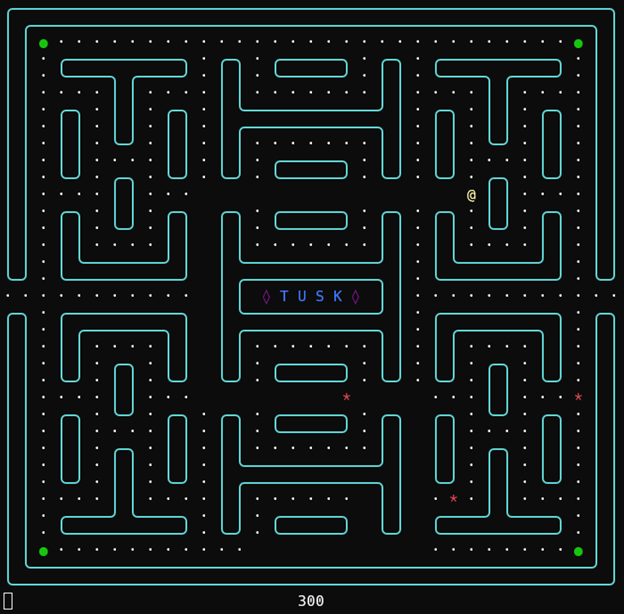 You control the yellow @ sign with the arrow keys.
The ghosts are the red asterisks,
but they turn into circles when they are vulnerable.
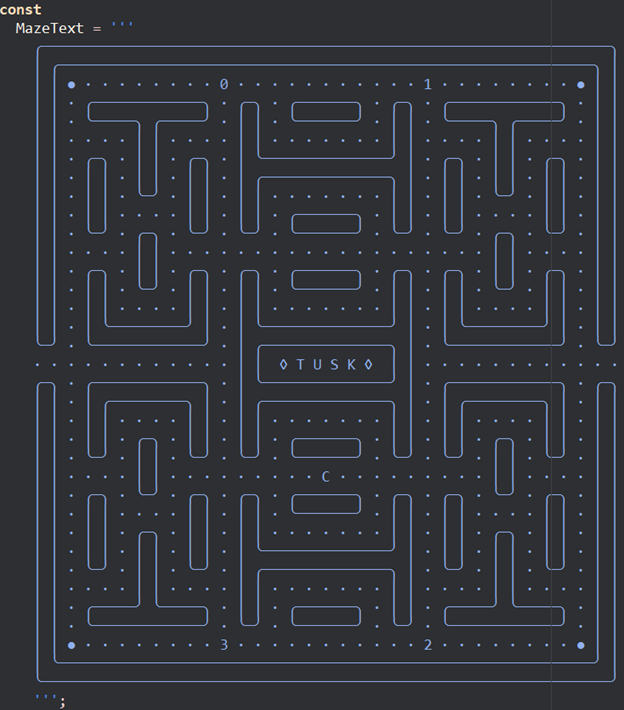
This program also uses Console.tusk, discussed above.
In addition, the maze itself resides in a separate file,
named TuskMaze.tusk…
You control the yellow @ sign with the arrow keys.
The ghosts are the red asterisks,
but they turn into circles when they are vulnerable.
This program also uses Console.tusk, discussed above.
In addition, the maze itself resides in a separate file,
named TuskMaze.tusk…
 The source code for the game itself is as follows…
// Tusk:Quiet
// Tusk:NoPause
{$Include Console.tusk}
{$Include TuskMaze.tusk}
const
UNI_POWER = #9679; // Power pill
UNI_DOT = #183; // Regular dot
UNI_TUSK = '@'; // TuskMan
UNI_GHOST = '*'; // Ghost
UNI_SCARED = 'o'; // Scared ghost
GhostCount = 4; // Number of ghosts
MS_PER_FRAME = 125; // Duration of each frame
POINTS_DOT = 5; // Points awarded for normal dot
POINTS_POWER = 25; // Points awarded for power pill
POINTS_GHOST = 200; // Points awarded for eating a ghost
// Number of frames that Power Pill Invulnerability lasts
POWER_FRAMES = 100;
// Percent chance a ghost doesn't move in a given frame
PCT_GHOST_NO_MOVE = 10;
// Percent chance ghost 0 does a 180
PCT_GHOST_0_UTURN = 5;
// Percent chance ghost 1 takes a turn
PCT_GHOST_1_TURN = 45;
// Percent chance ghost 2/3 takes a turn
PCT_GHOST_23_TURN = 25;
vkLeft = $25;
vkUp = $26;
vkRight = $27;
vkDown = $28;
vkEscape = $1B;
VK_LEFT = vkLeft;
VK_UP = vkUp;
VK_RIGHT = vkRight;
VK_DOWN = vkDown;
VK_ESCAPE = vkEscape;
type
TCell = (
cSolid, // Impassible space
cEmpty, // Empty space
cDot, // Dots are yummy
cPower, // Power pill
cPlayer, // TuskMan himself
cGhost0, // Inky
cGhost1, // Bliny
cGhost2, // Pinky
cGhost3, // Clyde
);
PCell = ^TCell;
TGhost = record
Location: TPoint;
Velocity: TPoint;
end;
TBoard = record
Width, Height: Integer;
Map: TArray<TArray<TCell>>; // [Height, Width]
Ghosts: TArray<TGhost>; // [GhostCount]
Player: TPoint;
Velocity: TPoint; // Player's movement
Text: IStringList;
GameOver: Boolean;
Score: Integer;
Power: Integer;
end;
procedure LoadBoard(
var Board: TBoard; const Text: string);
var
ls: IStringList;
x, y, i: Integer;
Line: string;
Src: PChar;
Dst: PCell;
p: TPoint;
begin
SetLength(Board.Ghosts, GhostCount);
Board.Ghosts[0].Velocity := Point(0, +1);
Board.Ghosts[1].Velocity := Point(-2, 0);
Board.Ghosts[2].Velocity := Point(0, -1);
Board.Ghosts[3].Velocity := Point(+2, 0);
ls := NewStringList(Text);
Board.Text := ls;
Board.Height := ls.Count;
Board.Width := Length(ls[0]);
for y := 1 to ls.Count-1 do begin
if Length(ls[y]) <> Board.Width then
DSRaise('Non-rectangular board');
end;
SetLength(Board.Map, Board.Height);
for y := 0 to Board.Height-1 do begin
SetLength(Board.Map[y], Board.Width);
Line := ls[y];
Src := PChar(Pointer(Line));
Dst := PCell(Board.Map[y]);
for x := 0 to Board.Width-1 do begin
case Src^ of
UNI_POWER: Dst^ := cPower;
UNI_DOT: Dst^ := cDot;
' ': Dst^ := cEmpty;
'0': Dst^ := cGhost0;
'1': Dst^ := cGhost1;
'2': Dst^ := cGhost2;
'3': Dst^ := cGhost3;
'C': Dst^ := cPlayer;
else Dst^ := cSolid;
end;
if Dst^ in [cPlayer..cGhost3] then begin
i := -1;
p := Point(x, y);
case Dst^ of
cGhost0: i := 0;
cGhost1: i := 1;
cGhost2: i := 2;
cGhost3: i := 3;
cPlayer: Board.Player := p;
end;
if i >= 0 then
Board.Ghosts[i].Location := p;
if Dst^ = cPlayer then begin
Dst^ := cEmpty;
Src^ := ' ';
end else begin
Dst^ := cDot;
Src^ := UNI_DOT;
end;
end;
Inc(Src);
Inc(Dst);
end;
end;
end;
procedure RenderFrame(const Board: TBoard);
var
x, y, i: Integer;
Line: string;
Dst: PChar;
Src: PCell;
Attr: PWord;
p: TPoint;
Attrs: TArray<Word>;
begin
SetLength(Attrs, Board.Width);
for y := 0 to Board.Height-1 do begin
Line := Copy(Board.Text[y]);
Dst := PChar(Pointer(Line));
Src := PCell(Board.Map[y]);
Attr := PWord(Attrs);
for x := 0 to Board.Width-1 do begin
if Src^ <> cSolid then begin
if Src^ = cEmpty then
Dst^ := ' ';
p := Point(x, y);
if Board.Player = p then
Dst^ := UNI_TUSK
else begin
for i := 0 to GhostCount-1 do
if Board.Ghosts[i].Location = p then begin
Dst^ := if Board.Power > 0 then UNI_SCARED else UNI_GHOST;
Break;
end;
end;
end;
case Dst^ of
UNI_GHOST: Attr^ := CON_LIGHT_RED;
UNI_SCARED:
if Board.Power < 5 then
Attr^ := CON_YELLOW
else if Board.Power < 15 then
Attr^ := CON_LIGHT_RED
else
Attr^ := CON_LIGHT_MAGENTA;
UNI_TUSK: Attr^ := CON_YELLOW;
UNI_POWER: Attr^ := CON_LIGHT_GREEN;
UNI_DOT: Attr^ := CON_WHITE;
' ': Attr^ := CON_BLACK;
'T', 'U', 'S', 'K': Attr^ := CON_LIGHT_BLUE;
Unicode.LozengeHollow: Attr^ := CON_MAGENTA;
else Attr^ := CON_LIGHT_CYAN;
end;
Inc(Src);
Inc(Dst);
Inc(Attr);
end;
Console.WriteStringAt(0, y, Line);
Console.WriteAttrsAt(0, y, Attrs);
end;
Line := DSFormat('%i', [Board.Score]);
if Board.Power > 0 then
Line := DSFormat('%s - POWER: %i', [Line, Board.Power]);
Line := ' ' + Line + ' ';
Console.WriteStringAt(
(Board.Width - Length(Line)) div 2, Board.Height, Line);
end;
function MovePlayer(var Board: TBoard; Vel: TPoint): Boolean;
var
p: TPoint;
c: PCell;
i: Integer;
begin
p := Board.Player + Vel;
if p.x < 0 then
p.x := Board.Width-1
else if p.x >= Board.Width then
p.x := 0;
c := @Board.Map[p.y][p.x];
if c^ = cSolid then
Exit(False);
Result := True;
Board.Player := p;
Board.Velocity := Vel;
for i := 0 to GhostCount-1 do
if p = Board.Ghosts[i].Location then begin
if Board.Power = 0 then begin
Board.GameOver := True;
Exit;
end;
Board.Ghosts[i].Location := TPoint.Zero;
Inc(Board.Score, POINTS_GHOST);
end;
case c^ of
cDot:
begin
c^ := cEmpty;
Inc(Board.Score, POINTS_DOT);
end;
cPower:
begin
c^ := cEmpty;
Inc(Board.Score, POINTS_POWER);
Inc(Board.Power, POWER_FRAMES);
end;
end;
end;
function RandomDirection: TPoint;
begin
case Random(4) of
0: Result := Point(0, +1);
1: Result := Point(0, -1);
2: Result := Point(+2, 0);
3: Result := Point(-2, 0);
else InternalError;
end;
end;
procedure MoveGhost(
var Board: TBoard; var Ghost: TGhost; Index: Integer);
var
Pct: Integer;
p: TPoint;
begin
if Ghost.Location = TPoint.Zero then
Exit;
if Random(100) < PCT_GHOST_NO_MOVE then
Exit;
if Index = 0 then begin
if Random(100) < PCT_GHOST_0_UTURN then begin
Ghost.Velocity.x := -Ghost.Velocity.x;
Ghost.Velocity.y := -Ghost.Velocity.y;
end;
end else begin
Pct := if Index = 1 then PCT_GHOST_1_TURN else PCT_GHOST_23_TURN;
if Random(100) < Pct then begin
var v: TPoint;
if Ghost.Velocity.x = 0 then
v := Point(Random(2)*4 - 2, 0)
else
v := Point(0, Random(2)*2 - 1);
p := Ghost.Location + v;
if p.x < 0 then
p.x := Board.Width-1
else if p.x >= Board.Width then
p.x := 0;
if Board.Map[p.y][p.x] <> cSolid then
Ghost.Velocity := v;
end;
end;
p := Ghost.Location + Ghost.Velocity;
if p.x < 0 then
p.x := Board.Width-1
else if p.x >= Board.Width then
p.x := 0;
if p = Board.Player then begin
if Board.Power = 0 then
Board.GameOver := True
else begin
Inc(Board.Score, POINTS_GHOST);
Ghost.Location := TPoint.Zero;
end;
Exit;
end;
while Board.Map[p.y][p.x] = cSolid do begin
Ghost.Velocity := RandomDirection;
p := Ghost.Location + Ghost.Velocity;
end;
Ghost.Location := p;
end;
procedure UpdateGame(var Board: TBoard; const Vel: TPoint);
var
i: Integer;
PlayerMoved: Boolean;
begin
for i := 0 to GhostCount-1 do
MoveGhost(Board, Board.Ghosts[i], i);
if Board.GameOver then
Exit;
PlayerMoved := False;
if Vel <> TPoint.Zero then
if MovePlayer(Board, Vel) then
PlayerMoved := True;
if not PlayerMoved then
if Board.Velocity <> TPoint.Zero then
MovePlayer(Board, Board.Velocity);
if Board.Power > 0 then
Dec(Board.Power);
end;
procedure GameLoop(var Board: TBoard);
var
keystroke: TKeystroke;
p: TPoint;
t: ITimer;
Elapsed, Remain: Integer;
begin
t := NewTimer;
while not Board.GameOver do begin
t.Restart;
Console.WriteStringAt(Board.Width + 1, 0, IntToStr(Elapsed));
while KeystrokeReady(kkNonModifier, False) do begin
keystroke := ReadKeystroke(kkNonModifier, False);
case keystroke.Key of
VK_UP: p := Point(0, -1);
VK_DOWN: p := Point(0, +1);
VK_LEFT: p := Point(-2, 0);
VK_RIGHT: p := Point(+2, 0);
VK_ESCAPE: Exit;
end;
end;
UpdateGame(Board, p);
RenderFrame(Board);
Elapsed := t.ElapsedMS;
Remain := MS_PER_FRAME - Elapsed;
if Remain > 0 then
Sleep(Remain);
end;
Write('Hit ENTER...');
Readln;
end;
procedure Main;
var
Board: TBoard;
begin
LoadBoard(Board, MazeText);
Console.SetTextAttr(CON_WHITE);
Console.ClearScreen;
for var i := 1 to Board.Height do
Writeln;
GameLoop(Board);
end;
Main;
Here are direct links to all relevant files…
The source code for the game itself is as follows…
// Tusk:Quiet
// Tusk:NoPause
{$Include Console.tusk}
{$Include TuskMaze.tusk}
const
UNI_POWER = #9679; // Power pill
UNI_DOT = #183; // Regular dot
UNI_TUSK = '@'; // TuskMan
UNI_GHOST = '*'; // Ghost
UNI_SCARED = 'o'; // Scared ghost
GhostCount = 4; // Number of ghosts
MS_PER_FRAME = 125; // Duration of each frame
POINTS_DOT = 5; // Points awarded for normal dot
POINTS_POWER = 25; // Points awarded for power pill
POINTS_GHOST = 200; // Points awarded for eating a ghost
// Number of frames that Power Pill Invulnerability lasts
POWER_FRAMES = 100;
// Percent chance a ghost doesn't move in a given frame
PCT_GHOST_NO_MOVE = 10;
// Percent chance ghost 0 does a 180
PCT_GHOST_0_UTURN = 5;
// Percent chance ghost 1 takes a turn
PCT_GHOST_1_TURN = 45;
// Percent chance ghost 2/3 takes a turn
PCT_GHOST_23_TURN = 25;
vkLeft = $25;
vkUp = $26;
vkRight = $27;
vkDown = $28;
vkEscape = $1B;
VK_LEFT = vkLeft;
VK_UP = vkUp;
VK_RIGHT = vkRight;
VK_DOWN = vkDown;
VK_ESCAPE = vkEscape;
type
TCell = (
cSolid, // Impassible space
cEmpty, // Empty space
cDot, // Dots are yummy
cPower, // Power pill
cPlayer, // TuskMan himself
cGhost0, // Inky
cGhost1, // Bliny
cGhost2, // Pinky
cGhost3, // Clyde
);
PCell = ^TCell;
TGhost = record
Location: TPoint;
Velocity: TPoint;
end;
TBoard = record
Width, Height: Integer;
Map: TArray<TArray<TCell>>; // [Height, Width]
Ghosts: TArray<TGhost>; // [GhostCount]
Player: TPoint;
Velocity: TPoint; // Player's movement
Text: IStringList;
GameOver: Boolean;
Score: Integer;
Power: Integer;
end;
procedure LoadBoard(
var Board: TBoard; const Text: string);
var
ls: IStringList;
x, y, i: Integer;
Line: string;
Src: PChar;
Dst: PCell;
p: TPoint;
begin
SetLength(Board.Ghosts, GhostCount);
Board.Ghosts[0].Velocity := Point(0, +1);
Board.Ghosts[1].Velocity := Point(-2, 0);
Board.Ghosts[2].Velocity := Point(0, -1);
Board.Ghosts[3].Velocity := Point(+2, 0);
ls := NewStringList(Text);
Board.Text := ls;
Board.Height := ls.Count;
Board.Width := Length(ls[0]);
for y := 1 to ls.Count-1 do begin
if Length(ls[y]) <> Board.Width then
DSRaise('Non-rectangular board');
end;
SetLength(Board.Map, Board.Height);
for y := 0 to Board.Height-1 do begin
SetLength(Board.Map[y], Board.Width);
Line := ls[y];
Src := PChar(Pointer(Line));
Dst := PCell(Board.Map[y]);
for x := 0 to Board.Width-1 do begin
case Src^ of
UNI_POWER: Dst^ := cPower;
UNI_DOT: Dst^ := cDot;
' ': Dst^ := cEmpty;
'0': Dst^ := cGhost0;
'1': Dst^ := cGhost1;
'2': Dst^ := cGhost2;
'3': Dst^ := cGhost3;
'C': Dst^ := cPlayer;
else Dst^ := cSolid;
end;
if Dst^ in [cPlayer..cGhost3] then begin
i := -1;
p := Point(x, y);
case Dst^ of
cGhost0: i := 0;
cGhost1: i := 1;
cGhost2: i := 2;
cGhost3: i := 3;
cPlayer: Board.Player := p;
end;
if i >= 0 then
Board.Ghosts[i].Location := p;
if Dst^ = cPlayer then begin
Dst^ := cEmpty;
Src^ := ' ';
end else begin
Dst^ := cDot;
Src^ := UNI_DOT;
end;
end;
Inc(Src);
Inc(Dst);
end;
end;
end;
procedure RenderFrame(const Board: TBoard);
var
x, y, i: Integer;
Line: string;
Dst: PChar;
Src: PCell;
Attr: PWord;
p: TPoint;
Attrs: TArray<Word>;
begin
SetLength(Attrs, Board.Width);
for y := 0 to Board.Height-1 do begin
Line := Copy(Board.Text[y]);
Dst := PChar(Pointer(Line));
Src := PCell(Board.Map[y]);
Attr := PWord(Attrs);
for x := 0 to Board.Width-1 do begin
if Src^ <> cSolid then begin
if Src^ = cEmpty then
Dst^ := ' ';
p := Point(x, y);
if Board.Player = p then
Dst^ := UNI_TUSK
else begin
for i := 0 to GhostCount-1 do
if Board.Ghosts[i].Location = p then begin
Dst^ := if Board.Power > 0 then UNI_SCARED else UNI_GHOST;
Break;
end;
end;
end;
case Dst^ of
UNI_GHOST: Attr^ := CON_LIGHT_RED;
UNI_SCARED:
if Board.Power < 5 then
Attr^ := CON_YELLOW
else if Board.Power < 15 then
Attr^ := CON_LIGHT_RED
else
Attr^ := CON_LIGHT_MAGENTA;
UNI_TUSK: Attr^ := CON_YELLOW;
UNI_POWER: Attr^ := CON_LIGHT_GREEN;
UNI_DOT: Attr^ := CON_WHITE;
' ': Attr^ := CON_BLACK;
'T', 'U', 'S', 'K': Attr^ := CON_LIGHT_BLUE;
Unicode.LozengeHollow: Attr^ := CON_MAGENTA;
else Attr^ := CON_LIGHT_CYAN;
end;
Inc(Src);
Inc(Dst);
Inc(Attr);
end;
Console.WriteStringAt(0, y, Line);
Console.WriteAttrsAt(0, y, Attrs);
end;
Line := DSFormat('%i', [Board.Score]);
if Board.Power > 0 then
Line := DSFormat('%s - POWER: %i', [Line, Board.Power]);
Line := ' ' + Line + ' ';
Console.WriteStringAt(
(Board.Width - Length(Line)) div 2, Board.Height, Line);
end;
function MovePlayer(var Board: TBoard; Vel: TPoint): Boolean;
var
p: TPoint;
c: PCell;
i: Integer;
begin
p := Board.Player + Vel;
if p.x < 0 then
p.x := Board.Width-1
else if p.x >= Board.Width then
p.x := 0;
c := @Board.Map[p.y][p.x];
if c^ = cSolid then
Exit(False);
Result := True;
Board.Player := p;
Board.Velocity := Vel;
for i := 0 to GhostCount-1 do
if p = Board.Ghosts[i].Location then begin
if Board.Power = 0 then begin
Board.GameOver := True;
Exit;
end;
Board.Ghosts[i].Location := TPoint.Zero;
Inc(Board.Score, POINTS_GHOST);
end;
case c^ of
cDot:
begin
c^ := cEmpty;
Inc(Board.Score, POINTS_DOT);
end;
cPower:
begin
c^ := cEmpty;
Inc(Board.Score, POINTS_POWER);
Inc(Board.Power, POWER_FRAMES);
end;
end;
end;
function RandomDirection: TPoint;
begin
case Random(4) of
0: Result := Point(0, +1);
1: Result := Point(0, -1);
2: Result := Point(+2, 0);
3: Result := Point(-2, 0);
else InternalError;
end;
end;
procedure MoveGhost(
var Board: TBoard; var Ghost: TGhost; Index: Integer);
var
Pct: Integer;
p: TPoint;
begin
if Ghost.Location = TPoint.Zero then
Exit;
if Random(100) < PCT_GHOST_NO_MOVE then
Exit;
if Index = 0 then begin
if Random(100) < PCT_GHOST_0_UTURN then begin
Ghost.Velocity.x := -Ghost.Velocity.x;
Ghost.Velocity.y := -Ghost.Velocity.y;
end;
end else begin
Pct := if Index = 1 then PCT_GHOST_1_TURN else PCT_GHOST_23_TURN;
if Random(100) < Pct then begin
var v: TPoint;
if Ghost.Velocity.x = 0 then
v := Point(Random(2)*4 - 2, 0)
else
v := Point(0, Random(2)*2 - 1);
p := Ghost.Location + v;
if p.x < 0 then
p.x := Board.Width-1
else if p.x >= Board.Width then
p.x := 0;
if Board.Map[p.y][p.x] <> cSolid then
Ghost.Velocity := v;
end;
end;
p := Ghost.Location + Ghost.Velocity;
if p.x < 0 then
p.x := Board.Width-1
else if p.x >= Board.Width then
p.x := 0;
if p = Board.Player then begin
if Board.Power = 0 then
Board.GameOver := True
else begin
Inc(Board.Score, POINTS_GHOST);
Ghost.Location := TPoint.Zero;
end;
Exit;
end;
while Board.Map[p.y][p.x] = cSolid do begin
Ghost.Velocity := RandomDirection;
p := Ghost.Location + Ghost.Velocity;
end;
Ghost.Location := p;
end;
procedure UpdateGame(var Board: TBoard; const Vel: TPoint);
var
i: Integer;
PlayerMoved: Boolean;
begin
for i := 0 to GhostCount-1 do
MoveGhost(Board, Board.Ghosts[i], i);
if Board.GameOver then
Exit;
PlayerMoved := False;
if Vel <> TPoint.Zero then
if MovePlayer(Board, Vel) then
PlayerMoved := True;
if not PlayerMoved then
if Board.Velocity <> TPoint.Zero then
MovePlayer(Board, Board.Velocity);
if Board.Power > 0 then
Dec(Board.Power);
end;
procedure GameLoop(var Board: TBoard);
var
keystroke: TKeystroke;
p: TPoint;
t: ITimer;
Elapsed, Remain: Integer;
begin
t := NewTimer;
while not Board.GameOver do begin
t.Restart;
Console.WriteStringAt(Board.Width + 1, 0, IntToStr(Elapsed));
while KeystrokeReady(kkNonModifier, False) do begin
keystroke := ReadKeystroke(kkNonModifier, False);
case keystroke.Key of
VK_UP: p := Point(0, -1);
VK_DOWN: p := Point(0, +1);
VK_LEFT: p := Point(-2, 0);
VK_RIGHT: p := Point(+2, 0);
VK_ESCAPE: Exit;
end;
end;
UpdateGame(Board, p);
RenderFrame(Board);
Elapsed := t.ElapsedMS;
Remain := MS_PER_FRAME - Elapsed;
if Remain > 0 then
Sleep(Remain);
end;
Write('Hit ENTER...');
Readln;
end;
procedure Main;
var
Board: TBoard;
begin
LoadBoard(Board, MazeText);
Console.SetTextAttr(CON_WHITE);
Console.ClearScreen;
for var i := 1 to Board.Height do
Writeln;
GameLoop(Board);
end;
Main;
Here are direct links to all relevant files…
You control the yellow @ sign with the arrow keys.
The ghosts are the red asterisks,
but they turn into circles when they are vulnerable.
This program also uses Console.tusk, discussed above.
In addition, the maze itself resides in a separate file,
named TuskMaze.tusk…
The source code for the game itself is as follows…
// Tusk:Quiet
// Tusk:NoPause
{$Include Console.tusk}
{$Include TuskMaze.tusk}
const
UNI_POWER = #9679; // Power pill
UNI_DOT = #183; // Regular dot
UNI_TUSK = '@'; // TuskMan
UNI_GHOST = '*'; // Ghost
UNI_SCARED = 'o'; // Scared ghost
GhostCount = 4; // Number of ghosts
MS_PER_FRAME = 125; // Duration of each frame
POINTS_DOT = 5; // Points awarded for normal dot
POINTS_POWER = 25; // Points awarded for power pill
POINTS_GHOST = 200; // Points awarded for eating a ghost
// Number of frames that Power Pill Invulnerability lasts
POWER_FRAMES = 100;
// Percent chance a ghost doesn't move in a given frame
PCT_GHOST_NO_MOVE = 10;
// Percent chance ghost 0 does a 180
PCT_GHOST_0_UTURN = 5;
// Percent chance ghost 1 takes a turn
PCT_GHOST_1_TURN = 45;
// Percent chance ghost 2/3 takes a turn
PCT_GHOST_23_TURN = 25;
vkLeft = $25;
vkUp = $26;
vkRight = $27;
vkDown = $28;
vkEscape = $1B;
VK_LEFT = vkLeft;
VK_UP = vkUp;
VK_RIGHT = vkRight;
VK_DOWN = vkDown;
VK_ESCAPE = vkEscape;
type
TCell = (
cSolid, // Impassible space
cEmpty, // Empty space
cDot, // Dots are yummy
cPower, // Power pill
cPlayer, // TuskMan himself
cGhost0, // Inky
cGhost1, // Bliny
cGhost2, // Pinky
cGhost3, // Clyde
);
PCell = ^TCell;
TGhost = record
Location: TPoint;
Velocity: TPoint;
end;
TBoard = record
Width, Height: Integer;
Map: TArray<TArray<TCell>>; // [Height, Width]
Ghosts: TArray<TGhost>; // [GhostCount]
Player: TPoint;
Velocity: TPoint; // Player's movement
Text: IStringList;
GameOver: Boolean;
Score: Integer;
Power: Integer;
end;
procedure LoadBoard(
var Board: TBoard; const Text: string);
var
ls: IStringList;
x, y, i: Integer;
Line: string;
Src: PChar;
Dst: PCell;
p: TPoint;
begin
SetLength(Board.Ghosts, GhostCount);
Board.Ghosts[0].Velocity := Point(0, +1);
Board.Ghosts[1].Velocity := Point(-2, 0);
Board.Ghosts[2].Velocity := Point(0, -1);
Board.Ghosts[3].Velocity := Point(+2, 0);
ls := NewStringList(Text);
Board.Text := ls;
Board.Height := ls.Count;
Board.Width := Length(ls[0]);
for y := 1 to ls.Count-1 do begin
if Length(ls[y]) <> Board.Width then
DSRaise('Non-rectangular board');
end;
SetLength(Board.Map, Board.Height);
for y := 0 to Board.Height-1 do begin
SetLength(Board.Map[y], Board.Width);
Line := ls[y];
Src := PChar(Pointer(Line));
Dst := PCell(Board.Map[y]);
for x := 0 to Board.Width-1 do begin
case Src^ of
UNI_POWER: Dst^ := cPower;
UNI_DOT: Dst^ := cDot;
' ': Dst^ := cEmpty;
'0': Dst^ := cGhost0;
'1': Dst^ := cGhost1;
'2': Dst^ := cGhost2;
'3': Dst^ := cGhost3;
'C': Dst^ := cPlayer;
else Dst^ := cSolid;
end;
if Dst^ in [cPlayer..cGhost3] then begin
i := -1;
p := Point(x, y);
case Dst^ of
cGhost0: i := 0;
cGhost1: i := 1;
cGhost2: i := 2;
cGhost3: i := 3;
cPlayer: Board.Player := p;
end;
if i >= 0 then
Board.Ghosts[i].Location := p;
if Dst^ = cPlayer then begin
Dst^ := cEmpty;
Src^ := ' ';
end else begin
Dst^ := cDot;
Src^ := UNI_DOT;
end;
end;
Inc(Src);
Inc(Dst);
end;
end;
end;
procedure RenderFrame(const Board: TBoard);
var
x, y, i: Integer;
Line: string;
Dst: PChar;
Src: PCell;
Attr: PWord;
p: TPoint;
Attrs: TArray<Word>;
begin
SetLength(Attrs, Board.Width);
for y := 0 to Board.Height-1 do begin
Line := Copy(Board.Text[y]);
Dst := PChar(Pointer(Line));
Src := PCell(Board.Map[y]);
Attr := PWord(Attrs);
for x := 0 to Board.Width-1 do begin
if Src^ <> cSolid then begin
if Src^ = cEmpty then
Dst^ := ' ';
p := Point(x, y);
if Board.Player = p then
Dst^ := UNI_TUSK
else begin
for i := 0 to GhostCount-1 do
if Board.Ghosts[i].Location = p then begin
Dst^ := if Board.Power > 0 then UNI_SCARED else UNI_GHOST;
Break;
end;
end;
end;
case Dst^ of
UNI_GHOST: Attr^ := CON_LIGHT_RED;
UNI_SCARED:
if Board.Power < 5 then
Attr^ := CON_YELLOW
else if Board.Power < 15 then
Attr^ := CON_LIGHT_RED
else
Attr^ := CON_LIGHT_MAGENTA;
UNI_TUSK: Attr^ := CON_YELLOW;
UNI_POWER: Attr^ := CON_LIGHT_GREEN;
UNI_DOT: Attr^ := CON_WHITE;
' ': Attr^ := CON_BLACK;
'T', 'U', 'S', 'K': Attr^ := CON_LIGHT_BLUE;
Unicode.LozengeHollow: Attr^ := CON_MAGENTA;
else Attr^ := CON_LIGHT_CYAN;
end;
Inc(Src);
Inc(Dst);
Inc(Attr);
end;
Console.WriteStringAt(0, y, Line);
Console.WriteAttrsAt(0, y, Attrs);
end;
Line := DSFormat('%i', [Board.Score]);
if Board.Power > 0 then
Line := DSFormat('%s - POWER: %i', [Line, Board.Power]);
Line := ' ' + Line + ' ';
Console.WriteStringAt(
(Board.Width - Length(Line)) div 2, Board.Height, Line);
end;
function MovePlayer(var Board: TBoard; Vel: TPoint): Boolean;
var
p: TPoint;
c: PCell;
i: Integer;
begin
p := Board.Player + Vel;
if p.x < 0 then
p.x := Board.Width-1
else if p.x >= Board.Width then
p.x := 0;
c := @Board.Map[p.y][p.x];
if c^ = cSolid then
Exit(False);
Result := True;
Board.Player := p;
Board.Velocity := Vel;
for i := 0 to GhostCount-1 do
if p = Board.Ghosts[i].Location then begin
if Board.Power = 0 then begin
Board.GameOver := True;
Exit;
end;
Board.Ghosts[i].Location := TPoint.Zero;
Inc(Board.Score, POINTS_GHOST);
end;
case c^ of
cDot:
begin
c^ := cEmpty;
Inc(Board.Score, POINTS_DOT);
end;
cPower:
begin
c^ := cEmpty;
Inc(Board.Score, POINTS_POWER);
Inc(Board.Power, POWER_FRAMES);
end;
end;
end;
function RandomDirection: TPoint;
begin
case Random(4) of
0: Result := Point(0, +1);
1: Result := Point(0, -1);
2: Result := Point(+2, 0);
3: Result := Point(-2, 0);
else InternalError;
end;
end;
procedure MoveGhost(
var Board: TBoard; var Ghost: TGhost; Index: Integer);
var
Pct: Integer;
p: TPoint;
begin
if Ghost.Location = TPoint.Zero then
Exit;
if Random(100) < PCT_GHOST_NO_MOVE then
Exit;
if Index = 0 then begin
if Random(100) < PCT_GHOST_0_UTURN then begin
Ghost.Velocity.x := -Ghost.Velocity.x;
Ghost.Velocity.y := -Ghost.Velocity.y;
end;
end else begin
Pct := if Index = 1 then PCT_GHOST_1_TURN else PCT_GHOST_23_TURN;
if Random(100) < Pct then begin
var v: TPoint;
if Ghost.Velocity.x = 0 then
v := Point(Random(2)*4 - 2, 0)
else
v := Point(0, Random(2)*2 - 1);
p := Ghost.Location + v;
if p.x < 0 then
p.x := Board.Width-1
else if p.x >= Board.Width then
p.x := 0;
if Board.Map[p.y][p.x] <> cSolid then
Ghost.Velocity := v;
end;
end;
p := Ghost.Location + Ghost.Velocity;
if p.x < 0 then
p.x := Board.Width-1
else if p.x >= Board.Width then
p.x := 0;
if p = Board.Player then begin
if Board.Power = 0 then
Board.GameOver := True
else begin
Inc(Board.Score, POINTS_GHOST);
Ghost.Location := TPoint.Zero;
end;
Exit;
end;
while Board.Map[p.y][p.x] = cSolid do begin
Ghost.Velocity := RandomDirection;
p := Ghost.Location + Ghost.Velocity;
end;
Ghost.Location := p;
end;
procedure UpdateGame(var Board: TBoard; const Vel: TPoint);
var
i: Integer;
PlayerMoved: Boolean;
begin
for i := 0 to GhostCount-1 do
MoveGhost(Board, Board.Ghosts[i], i);
if Board.GameOver then
Exit;
PlayerMoved := False;
if Vel <> TPoint.Zero then
if MovePlayer(Board, Vel) then
PlayerMoved := True;
if not PlayerMoved then
if Board.Velocity <> TPoint.Zero then
MovePlayer(Board, Board.Velocity);
if Board.Power > 0 then
Dec(Board.Power);
end;
procedure GameLoop(var Board: TBoard);
var
keystroke: TKeystroke;
p: TPoint;
t: ITimer;
Elapsed, Remain: Integer;
begin
t := NewTimer;
while not Board.GameOver do begin
t.Restart;
Console.WriteStringAt(Board.Width + 1, 0, IntToStr(Elapsed));
while KeystrokeReady(kkNonModifier, False) do begin
keystroke := ReadKeystroke(kkNonModifier, False);
case keystroke.Key of
VK_UP: p := Point(0, -1);
VK_DOWN: p := Point(0, +1);
VK_LEFT: p := Point(-2, 0);
VK_RIGHT: p := Point(+2, 0);
VK_ESCAPE: Exit;
end;
end;
UpdateGame(Board, p);
RenderFrame(Board);
Elapsed := t.ElapsedMS;
Remain := MS_PER_FRAME - Elapsed;
if Remain > 0 then
Sleep(Remain);
end;
Write('Hit ENTER...');
Readln;
end;
procedure Main;
var
Board: TBoard;
begin
LoadBoard(Board, MazeText);
Console.SetTextAttr(CON_WHITE);
Console.ClearScreen;
for var i := 1 to Board.Height do
Writeln;
GameLoop(Board);
end;
Main;
Here are direct links to all relevant files…
⏱ Last Modified: 2/15 10:06:11 am